
Some investor friends pointed me to Vincorion SE (XTRA:V1NC). I’m glad they did. It has several traits I look for: a secular growth market, a structural moat, a large recurring-revenue base, and a stock the market still ignores. The share price has been lackluster since the early-2026 IPO.
History
Vincorion’s origin dates back to 1962 when it was part of the German conglomerate AEG. At that time, focused on aerospace technology, such as rescue winches for helicopters (a current business line), on-board generators for commercial aircraft, and solar cells for satellites. After several sales and mergers, the company was merged with Jenoptik AG in 1997. Jenoptik renamed the company Vincorion in 2019 and began a sale process. In 2021, Vincorion was sold to the British private equity firm, Star Capital (“Star”). The deal was closed in 2022 a few months after Russia invaded Ukraine – talk about timing!
Star bought Vincorion at what now looks like trough production and trough valuation. It promoted from within on the finance side, then rode the post-invasion order wave as Europe rearmed. The backlog went from a few hundred million euros to more than a billion. Operations stayed simple: expand existing plants, skip M&A, fund R&D to qualify the next-generation electric rescue hoist. In 2024 Star installed a new CEO and put the governance in place for a listing. In March 2026 Vincorion listed on Frankfurt. No cash went into the company. Star cut its stake to about 48% and remains the anchor.
Product Lines and Structural Advantages
Vehicle Systems (VS)
VS is 48% of H1 2026 revenue and almost entirely defense. It supplies gun and turret stabilization plus onboard power for the Leopard 2, the Puma IFV, the Panzerhaubitze 2000 self-propelled howitzer, and the Boxer. Watch the clip below if you want to see why a gun that stays on target at speed is hard to replace. Germany is the home market; a large and rising share of orders now comes from other European customers.
Power Systems (PS)
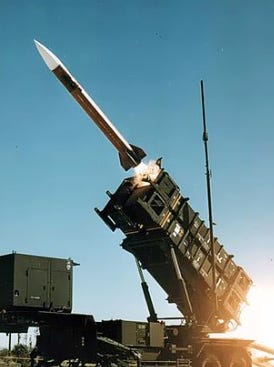
PS is about 30% of H1 2026 revenue and almost entirely defense. The crown jewel is Patriot.
Vincorion is the global supplier of Patriot’s electrical power plant — the equipment that runs the radar, the Engagement Control Station, the command-and-comms vans, and the launchers. It does not make the missile or the radar face. It makes the 400 Hz diesel-electric heart without which those boxes do not turn on. Vincorion holds that role across the large majority of non-U.S. Patriot operators. The U.S. Army still buys EPP-III spares from the same shop through Vincorion. Company history puts the origin in a competitor generator failure during the first Gulf War; once qualified, the Army and Raytheon did not dual-source the plant. Vincorion also supplies power for the IRIS-T SLM.
Patriot Missile System
Iris-T SLM

Aviation
Aviation is 22% of H1 2026 revenue. It is the only real commercial pocket, not a commercial business. The mix is rescue hoists (military NH90 plus the new civil/military ERH premierV) and heating systems for Airbus-family airliners and some military/LCA aircraft. Vincorion funded the next-generation electric rescue hoist and won OEM position on the Airbus H145. First flight is due in October 2026; first deliveries in H1 2027. A clean H145 launch is the path to STCs on other Airbus types and, later, Leonardo, Bell, and Sikorsky.
Structural Advantages
Vincorion is sole source on about 85% of revenue. That is qualification history, not a slogan. Rearmament is lifting the top line. It is also lifting the aftermarket: roughly 55% of sales are maintenance and spares on platforms that stay in the field for decades.
Growth and Margins
Revenue rose 18% in 2025. EBITDA margins were 18%. Street has 2026 revenue at roughly 30% growth and EBITDA margins moving toward 21%, then about €547 million of revenue and 25% EBITDA margins by 2030. I think those numbers can prove light.
Why the Street may be short: NATO defense spend is expected to compound around 9% through the period; Germany closer to 13%. Vincorion’s total order book was €1.21 billion at 30 June 2026, up 12% from year-end 2025. That is years of visibility. The next-gen hoist is probably not in the Street’s models. Also, battlefield electrification is a house skill — more drones means more forward power, which is this company’s work. Mix and volume should also lift margins as fixed plant cost is diluted.
Valuation
On Street numbers I get 6.4% and 7.8% FCF yield for 2027 and 2028. That ignores the capitalized investment in the next-gen hoist. If earnings beat, those yields will prove to be low.
Summary
Vincorion is a ~€1 billion, underfollowed German supplier with a sole-source position on about 85% of sales, a €1.2 billion backlog, and more than half of revenue from maintenance. Rearmament is the tailwind. The H145 hoist is the option. Margins are already high-teens, but growing, and the capex need is small. The stock is illiquid. Good news should fix that — and bring more holders in.
Disclaimer: For educational and entertainment purposes only. Not a solicitation to buy or sell any security. Do you own due diligence.
Thanks for this 👍.Look like owners star capital still keen to sell down their stake ?
Interesting. What's the thesis?
Is it that 6.4% FCF yield will prove to be conservative, or that this deserves a terminal multiple in excess of 6.4%, ... ?
Any idea where you see FCF land eventually as its market matures?
Edit: correction, I meant ~7%.